
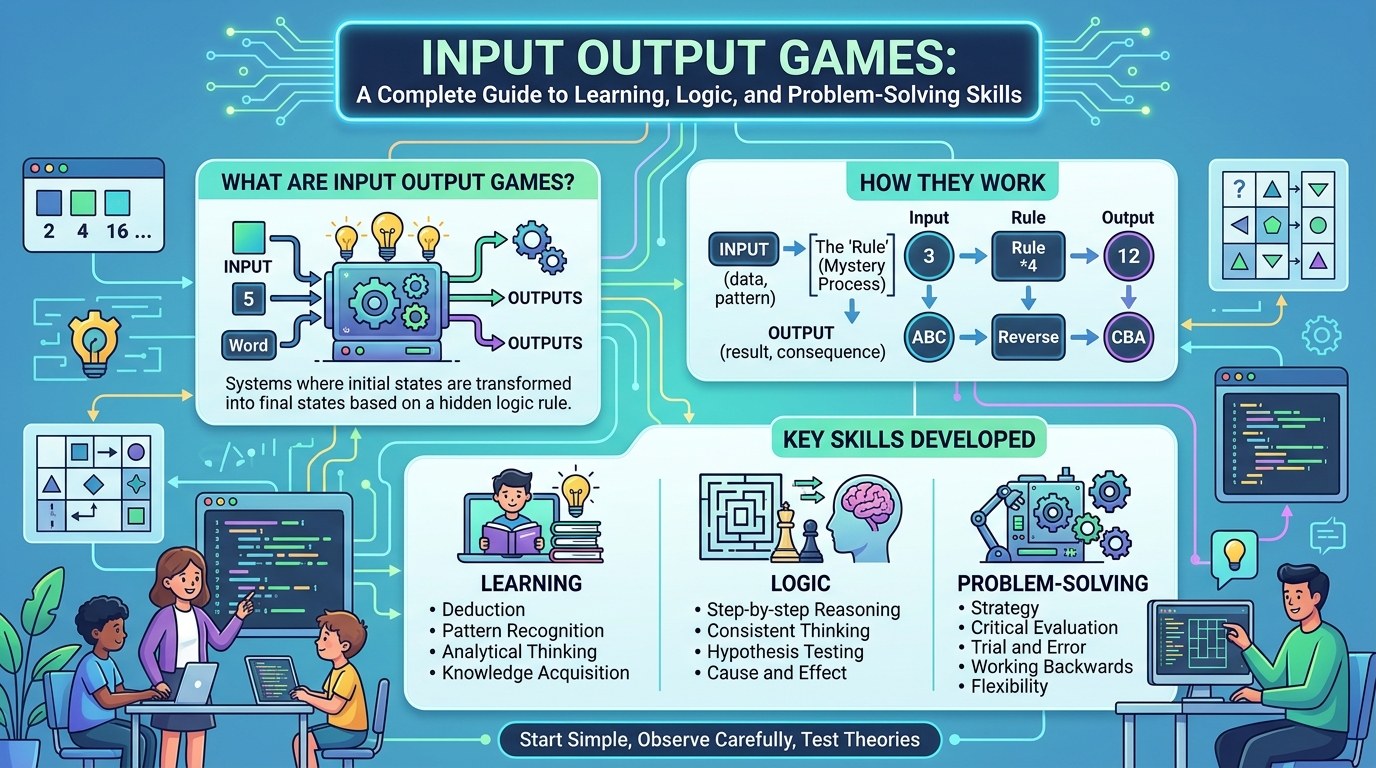
Input output games have become increasingly popular as educational and brain-training activities that challenge players to recognize patterns, understand logical relationships, and develop critical thinking skills. These games require participants to examine given inputs, identify the rules that transform them, and determine the correct outputs. They are widely used in classrooms, competitive examinations, coding exercises, and cognitive development programs because they strengthen analytical reasoning and problem-solving abilities. Whether played through digital platforms, worksheets, or interactive classroom activities, input output games encourage learners to think systematically and improve decision-making skills. As education continues to emphasize logical reasoning and computational thinking, these games serve as an engaging way to develop essential cognitive abilities while making learning enjoyable for students of all ages.
What Are Input Output Games?
Input games are logical activities where players analyze a set of inputs and determine the corresponding outputs by identifying hidden rules or patterns. The input may consist of numbers, letters, words, symbols, or images, while the output reflects the result after applying a specific transformation. Participants must carefully observe relationships between examples to discover the underlying logic before solving new challenges. These games appear in educational programs, aptitude tests, mathematics exercises, and computer science learning activities. Their primary objective is to improve reasoning skills while encouraging learners to recognize sequences, classify information, and solve problems independently using structured thinking and logical analysis.
Importance of Input Output Games in Education
Input output games play a valuable role in modern education by helping students strengthen their analytical and reasoning abilities. Teachers often use these activities to encourage active participation while introducing mathematical concepts, logical thinking, and computational skills. Instead of memorizing information, students learn to identify patterns and understand relationships between different elements. This learning method improves concentration, creativity, and confidence when solving unfamiliar problems. Input games also prepare learners for standardized tests and competitive examinations where logical reasoning questions are common. By combining entertainment with education, these games create an engaging classroom environment that motivates students to develop lifelong problem-solving skills.
Key Features of Input Output Games
Several important features make input output games effective learning tools. They rely on pattern recognition, logical reasoning, rule identification, and step-by-step analysis to reach correct answers. Many games gradually increase in difficulty, allowing learners to build confidence before attempting advanced challenges. They may include numbers, letters, words, colors, symbols, or mixed data formats to encourage flexible thinking. Immediate feedback helps players understand mistakes and improve their reasoning process. Digital versions often provide interactive experiences with progress tracking and adaptive difficulty levels. Together, these features create an enjoyable learning experience while strengthening analytical thinking, memory, concentration, and decision-making abilities.
Benefits of Playing Input Output Games
Input games provide numerous benefits for learners of different ages and educational backgrounds. Regular practice improves logical reasoning, analytical thinking, observation skills, and attention to detail. Players become better at recognizing patterns and solving complex problems through structured analysis rather than guessing. These games also enhance memory retention because participants must remember rules and apply them consistently. Students preparing for aptitude tests, coding interviews, or competitive examinations often use input output games to sharpen their reasoning abilities. Beyond academics, these activities improve everyday decision-making by encouraging organized thinking, careful analysis, and confidence when facing unfamiliar situations or challenging tasks.
Applications of Input Output Games
Input output games are used across various educational and professional settings because of their ability to develop logical reasoning. Schools include them in mathematics and science lessons to improve analytical skills, while coding boot camps use similar exercises to teach programming logic and algorithm design. Employers often incorporate input output questions into aptitude assessments during recruitment processes. Puzzle enthusiasts enjoy these games as mental exercises that improve concentration and cognitive flexibility. Online learning platforms also feature interactive versions that allow learners to practice independently. Their wide range of applications demonstrates their effectiveness in building essential thinking skills for both academic success and career development.
Challenges in Solving Input Output Games
Although input output games are enjoyable, many learners initially find them challenging because the transformation rules are not immediately obvious. Some puzzles require multiple logical steps, making them more difficult to solve without careful observation. Players may become confused if they focus on incorrect patterns or overlook important details within the input data. Time pressure during examinations can also increase the difficulty of solving these problems accurately. Consistent practice, patience, and systematic analysis help overcome these challenges. Learning to break complex problems into smaller steps enables participants to identify patterns more efficiently and develop stronger reasoning skills over time.
Future of Input Output Games in Digital Learning
The future of input output is closely connected with advancements in educational technology and digital learning. Artificial intelligence is making these games more adaptive by adjusting difficulty according to individual performance. Gamified learning platforms are incorporating interactive challenges that keep students engaged while improving logical reasoning and computational thinking. Mobile applications provide convenient access to thousands of puzzles for continuous practice anywhere and anytime. Virtual classrooms are also integrating input output games into collaborative learning activities that encourage teamwork and communication. As technology continues to evolve, these games will remain valuable educational resources for developing essential twenty-first-century problem-solving skills.
Tips to Improve Performance in Input Output Games
Improving performance in input output games requires consistent practice and a structured approach to solving problems. Players should begin by carefully observing examples to identify repeating patterns before attempting answers. Writing down possible rules can help eliminate incorrect assumptions and organize thinking. Starting with simpler puzzles builds confidence and strengthens foundational reasoning skills before progressing to more complex challenges. Practicing different types of input output games also develops flexibility in recognizing various logical patterns. Reviewing mistakes and understanding why an answer was incorrect is equally important because it prevents repeated errors and steadily improves overall analytical ability.
Conclusion
Input output games are much more than entertaining puzzles because they develop valuable reasoning, analytical, and problem-solving skills that benefit learners throughout their academic and professional lives. By encouraging players to recognize patterns, identify logical rules, and think systematically, these games strengthen critical thinking and computational abilities in an engaging way. Their applications extend from classrooms and competitive examinations to coding education and workplace assessments. Although some challenges may arise, regular practice and strategic thinking significantly improve performance. As digital education continues to grow, input games will remain an effective and enjoyable tool for building the logical skills needed for success in an increasingly technology-driven world.